

Imagine someone asking ChatGPT to recommend the best blogging platform for beginners. Instead of opening ten different websites, they receive a response comparing WordPress, Blogger, and other platforms, along with explanations of which option might suit their needs. Now, imagine your website has a detailed article that answers this exact question. You have explained the differences between the platforms, discussed their limitations, and helped readers understand which option makes sense for their situation. Will ChatGPT mention your website in its answer?
It might, but publishing a relevant article alone does not guarantee that it will.
This is where AI search optimization comes into the picture. As people use AI-powered tools to research products, compare services, understand complicated subjects, and find solutions to everyday problems, website owners have a discovery channel to consider. The challenge is understanding how these tools access information, what makes content useful to readers, and how to improve your website’s chances of being discovered.
If you have already invested time in SEO, you do not need to abandon your existing strategy. Many of the fundamentals remain relevant, including technical accessibility, useful content, clear website structure, and a proper understanding of search intent. What you need is a better understanding of how these practices apply to AI-assisted search.
In this guide, we’ll explore the stepwise process of making your website accessible to relevant crawlers, improving your content, building credibility, measuring visibility, and avoiding common mistakes. By the end, you should have a practical plan for improving your website without relying on unverified shortcuts or chasing every new AI marketing trend.
What Is AI Search Optimization?
In simple terms,
AI search optimization is the process of improving your website and its content so that AI-powered search systems can discover, understand, retrieve, and potentially reference your information when responding to relevant questions.
Think about tools such as ChatGPT Search, Google Search with AI Overviews and AI Mode, and Perplexity. People use these services to ask questions in natural language, compare alternatives, and explore topics through follow-up questions. Depending on the product and query, the response may combine information from multiple sources and provide links to the websites used.
Consider someone searching for the best SEO tools for beginners. They might be interested in free keyword research tools, website analytics, and ways to monitor their rankings. Instead of searching for each requirement separately, they could ask an AI tool to recommend a combination that suits their budget and experience level.
For your website to be useful in this situation, your content needs to address the underlying problem, explain the available options, and help the reader make an informed decision.
AI search optimization brings several activities together:
- Making your website accessible to the relevant search and AI crawlers.
- Creating useful content that answers real questions.
- Organizing information so readers and automated systems can understand it.
- Supporting important claims with reliable sources.
- Demonstrating relevant experience and subject knowledge.
- Connecting related articles through meaningful internal links.
- Monitoring search performance and any available AI referral traffic.
You may also encounter terms such as generative engine optimization (GEO) and answer engine optimization (AEO). These overlap with AI search optimization, although practitioners do not always use them in the same way.
For this guide, AI search optimization refers to the broader effort to improve your website’s visibility across AI-assisted discovery experiences.
How Is AI Search Different From Traditional SEO?
Traditional search engines generally present a list of results that users can browse and open individually. AI-powered search experiences may instead generate a synthesized answer, draw on information from several sources, and display citations or links that allow users to explore the underlying information.
Consider a small business owner researching email marketing software. On a conventional search results page, they might visit several review websites, compare pricing pages, and read product documentation before making a decision. An AI-powered search experience may summarize the available options and link to selected sources. Your article could become one of those sources, but it could also be absent from the answer.
Remember: A good Google ranking does not automatically guarantee a citation in every AI product.
Here is how the two discovery experiences differ:
| Area | Traditional Search | AI-Powered Search |
|---|---|---|
| User behavior | Users often browse a list of results | Users may ask detailed questions and follow-ups |
| Information discovery | Users visit individual pages to gather information | Systems may retrieve information and generate a combined response |
| Website visibility | Rankings, snippets, and links influence discovery | Citations, links, and inclusion in answers may influence discovery |
| Content opportunity | Match search intent and provide a useful page | Provide relevant, trustworthy information that can support an answer |
| Measurement | Impressions, clicks, rankings, and conversions | Traditional metrics plus available AI referral and visibility data |
These differences matter, but they do not make traditional SEO irrelevant. Google’s official guidance on AI features and your website explains that the foundational SEO practices used for Google Search continue to apply to its AI search features. There is no separate set of special requirements that guarantees inclusion in AI Overviews or AI Mode. You still need an accessible website, useful content, and a clear understanding of what your audience wants.
AI search optimization builds on that foundation rather than replacing it.
Why AI Search Optimization Matters for Website Owners
Whether you run a personal blog, a business website, or a content-heavy publication, in today’s landscape, AI search is worth understanding because it changes the way people discover information. The opportunity isn’t the same for every website. For example, a publisher that depends heavily on informational search traffic may face different challenges from a business that wants qualified leads or product enquiries. So,
Your strategy should reflect the audience you want to reach and the outcomes that matter to your business.
People Can Research a Topic Without Visiting Multiple Websites
AI-powered search tools can answer questions that previously required several searches and website visits. Someone researching how to start a blog, for example, might ask about domain registration, hosting costs, WordPress installation, and SEO within the same conversation.
This can create a challenge for publishers because a user may find some of the information they need without clicking through to every source. At the same time, a relevant citation can introduce your website to someone who has never encountered your brand.
For this reason, do not judge AI search only by the number of clicks it sends to your website. Consider whether your content reaches the right audience, builds familiarity with your brand, and contributes to meaningful outcomes.
Your Website Can Be Discovered Beyond a Single Search Engine
Your potential readers do not all use the same discovery tool. One person may use Google, another may research through ChatGPT, and someone else may use Perplexity to compare products or investigate a business. Each service has its own systems, access rules, and ways of presenting information. You cannot assume that a page visible in Google will automatically appear in every AI-generated answer.
It makes sense to understand the platforms your audience uses and ensure that your website is accessible to the services you actually want to reach. This is a more useful approach than trying to optimize for every new AI product without considering whether it matters to your audience.
Specific, Helpful Content Gives Readers a Reason to Choose Your Website
Imagine two articles about keyword research. The first defines keywords, lists a few benefits, and recommends using SEO tools. The second explains how to find relevant keywords, evaluate search intent, filter irrelevant ideas, and prioritize topics for a small website. It also includes a worked example and discusses mistakes beginners commonly make.
The second article offers readers more practical value. It answers additional questions and helps someone move from understanding a concept to applying it. This does not guarantee that an AI system will select the article as a source. However, it gives the page a clearer purpose and makes it more useful to the people it was written for.
Rankings Are Only One Part of Your Content Performance
A page that ranks well in Google can remain valuable even if it does not appear in an AI-generated answer. Similarly, a page with limited organic traffic might occasionally receive a relevant visit from an AI search service. These are different visibility outcomes, and you should measure them accordingly. If you focus only on keyword rankings, you may overlook some discovery channels. If you focus exclusively on AI citations, you may neglect traffic, enquiries, and conversions that already matter to your business.
A sensible strategy accounts for both.
How AI Search Engines Find and Use Website Content
Before making changes to your website, it helps to understand the basic process behind AI-assisted search. The exact systems differ across products, but three concepts are particularly useful: crawling, retrieval, and answer generation.
Crawling: Can the System Access Your Website?
Crawling involves automated systems visiting web pages to retrieve their content. Search engines and AI services may operate different crawlers for different purposes. For instance, a service may use one crawler for search-related discovery and another for collecting information used in model training.
These purposes should not be confused.
Check out the official crawler documentation of OpenAI to learn about the functions of its crawlers, while Perplexity has its own documentation for web crawlers.
If you want your content to be available to an AI search service, start by understanding which crawler or access mechanism the service uses and what its documentation says.
Check the following:
- Is the page publicly accessible?
- Does your robots.txt file block the relevant crawler?
- Does your hosting provider, firewall, or security plugin block automated requests?
- Does the page require a login to access its main content?
- Does the page return the correct HTTP status code?
- Are important resources or content elements inaccessible?
A page that cannot be retrieved through a blocked access path cannot be used directly by a system through that path. However, allowing a crawler does not guarantee that the page will be indexed, retrieved for a question, or cited in an answer.
Indexing and Retrieval: Is Your Content Available When It Is Needed?
Crawling and indexing are related, but they are not the same thing. A search engine may crawl a page and decide whether to include it in its index. An AI search product may use its own retrieval systems, search indexes, or other information sources when responding to a query.
You May Find This Guide Useful: What Are Crawlability and Indexability of a Website | SEMRUSH Guide
When someone asks a question, the system needs to identify information that is relevant to that particular request.
For example, an article titled “How to Choose a WordPress Theme” might be relevant to a question about website design. However, if it only discusses visual appearance and says nothing about performance, accessibility, or mobile usability, it may not be useful for a question focused on those concerns.
This is why the actual content of your page matters. The title tells readers what the page is about, but the content needs to deliver on that promise.
Answer Generation: Will Your Page Be Referenced?
After relevant information has been retrieved, an AI-powered system may use it to generate a response. Whether your page appears as a citation depends on the product, the query, the available sources, and the system’s selection process.
You cannot directly control this stage. What you can control is the quality and accessibility of your content, the accuracy of your claims, and how clearly your pages address their intended topics.
There is no reliable formula that guarantees an AI citation every time someone asks a relevant question. Treat claims such as “add this schema and ChatGPT will cite you” with caution unless the claim is supported by the platform’s actual documentation.
How to Optimize Your Website for AI Search
The practical work starts with your existing website. Before rewriting dozens of articles, check whether your important pages can be accessed, whether they answer the questions readers are asking, and whether your content is organized in a way that makes sense.
The following nine steps build on established SEO practices and the documented behavior of AI-assisted search systems. They are not a secret ranking formula, and you should evaluate them in the context of your own website.
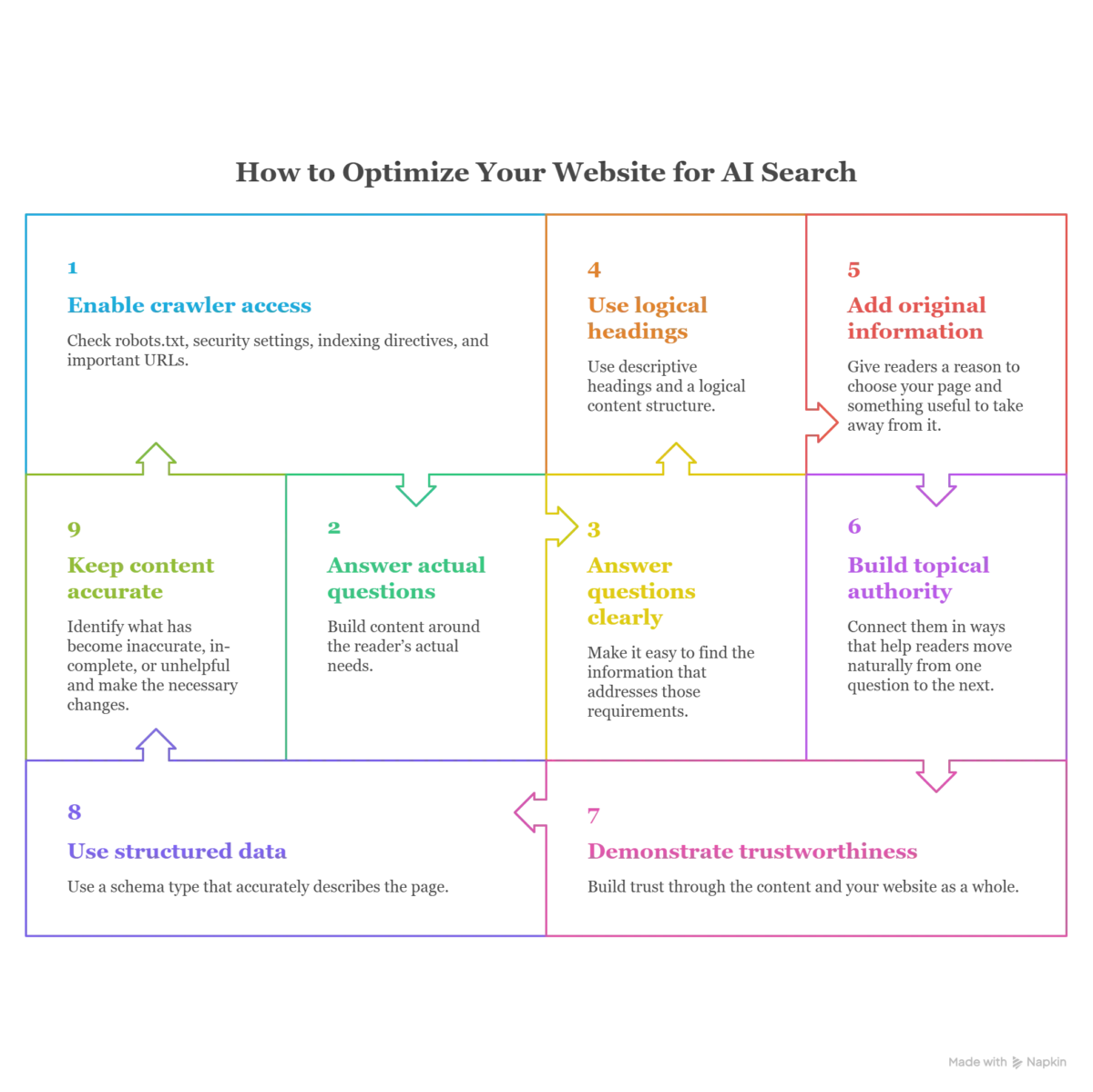
Step 1: Make Sure Search Engines and Relevant AI Crawlers Can Access Your Content
Start with the technical basics. If your pages are blocked, inaccessible, or difficult to retrieve, content improvements alone will not solve the problem.
For a WordPress website, review your robots.txt file, security settings, indexing directives, and important URLs.
Your robots.txt file provides crawlers with instructions about which areas of your website they may access. Check whether the rules block important pages or relevant crawlers, but do not copy a configuration from another website without understanding what it does.
Security plugins, firewalls, content delivery networks, and hosting providers can also affect automated requests. If a crawler appears to be blocked, check your server logs and security settings before making changes. Verify that a request genuinely came from the service it claims to represent, especially before creating exceptions.
You should also check whether important pages are publicly accessible, whether accidental noindex directives are present, whether canonical tags point to the correct URLs, and whether your pages return errors.
Use Google Search Console to understand how Google discovers and indexes your pages and how they perform in Google Search. Review your important URLs and investigate indexing problems rather than assuming every published article is automatically available in search.
One important distinction: allowing an AI crawler and allowing a search engine to index your website are separate considerations. Review the requirements for each service you want to reach.
Step 2: Create Content That Answers the Actual Question
Move from writing around a topic to solving a specific problem.
Take the keyword “content creation strategy.” A basic article might define the term, list a few benefits, and conclude by recommending consistency. That may introduce the subject, but it does not necessarily help someone who needs to build a working strategy for a business.
A more useful article would explain how to identify the intended audience, select topics based on audience needs, evaluate keywords and search intent, plan a realistic publishing schedule, distribute content, and measure results.
Before writing or updating an article, ask yourself:
- What is the reader trying to accomplish?
- What do they need to understand before they can act?
- Which questions are likely to arise next?
- What examples or evidence would help them make a decision?
- What should they be able to do after reading?
These questions help you build content around the reader’s actual needs. They also give you a clearer basis for deciding which information belongs in the article and which details would be better covered in a separate, related resource.
This approach aligns with Google’s guidance on creating helpful, reliable, people-first content.
Step 3: Answer Important Questions Clearly
AI search queries often contain several requirements in a single question. Someone asking, “What is the best free keyword research tool for a beginner using WordPress?” is not simply asking for a definition of keyword research. They want a recommendation that considers cost, experience level, and website platform.
Your article should make it easy to find the information that addresses those requirements.
A useful explanation might cover what the tool does, whether a free version is available, what a beginner can accomplish with it, its limitations, and how it compares with relevant alternatives. Link to the official documentation when readers need to verify features or pricing.
You do not need to turn every paragraph into a short answer or reduce a detailed article to a collection of bullet points. Context still matters. A comparison table can help readers evaluate products quickly, while the surrounding explanation describes the trade-offs and the situations in which each option makes sense.
Remember:
The goal is to make your content easy to navigate without stripping away the detail needed to make an informed decision.
Step 4: Use Descriptive Headings and a Logical Content Structure
Headings help readers understand how a page is organized and what each section covers. They also provide useful context about the relationships between different parts of an article.
For example, a guide about WordPress SEO could use headings such as:
- What Is WordPress SEO?
- How to Set Up Basic SEO Settings
- How to Optimize WordPress Blog Posts
- How to Improve Website Speed
- How to Monitor SEO Performance
- Common WordPress SEO Mistakes
Each section addresses a distinct part of the topic, allowing readers to move directly to the information they need.
Avoid headings that promise an answer but provide very little information. A heading such as “The Secret to SEO Success” tells the reader almost nothing about what follows. Descriptive headings set clearer expectations and make the article easier to follow.
You should also avoid forcing your primary keyword into every heading. Use it where it fits naturally, and cover related concepts when they help readers understand the subject.
Step 5: Add Original Information That Readers Cannot Get From Every Other Article
Many articles cover the same definitions, repeat the same advice, and recommend the same tools. Publishing another article with identical information gives readers little reason to choose your website.
Before publishing, consider what your page contributes. It could include a worked example, a comparison that explains when each option is appropriate, a process you have tested, original research, screenshots showing how to complete a task, or lessons learned from an unsuccessful approach.
For example, an article about improving organic traffic could explain how to investigate a decline in Google Search Console. You could show readers how to compare date ranges, examine affected pages, separate branded from non-branded queries where appropriate, and check whether the decline coincides with a technical issue.
That is more useful than simply telling people to “write better content.”
Only include first-hand claims when you can support them with your experience. If you have not tested a tool or method, explain what its documentation says rather than presenting the information as something you personally tried.
Originality is not about making every sentence sound different. It is about giving readers a reason to choose your page and something useful to take away from it.
Step 6: Build Topical Authority Through Related Content
If you publish several articles about related subjects, connect them in ways that help readers move naturally from one question to the next. This is where topic clusters and internal linking become useful.
Imagine your website covers digital marketing. Your central content strategy guide could connect to supporting articles about keyword research, SEO fundamentals, blog writing, AI search optimization, content distribution, and WordPress setup.
Each supporting article should have a clear purpose of its own.
For example, your keyword research guide can explain how to find and evaluate keywords in depth. The content strategy article can explain where keyword research fits into the larger planning process and link to that guide for readers who want to learn the details.
This creates a connected experience for your audience. It also helps search engines discover related pages and understand how your content is organized.
However, publishing 50 articles about one subject does not automatically establish authority. Your content needs to be useful, relevant, accurate, and sufficiently distinct to justify its existence. Treat your pillar pages as genuine resources, not as pages that simply link to everything you have published.
Step 7: Demonstrate Experience, Expertise, and Trustworthiness
Readers need reasons to trust the information you provide. AI search systems also need to identify relevant information when generating answers, although the exact selection mechanisms differ across products.
Google discusses Experience, Expertise, Authoritativeness, and Trustworthiness, commonly called E-E-A-T, in its Search Quality Rater Guidelines.
E-E-A-T is a framework for evaluating content quality. It should not be treated as a single score that you can increase by adding an author biography or a few external links.
Instead, build trust through the content and your website as a whole.
- Include a clear author profile that helps readers understand who wrote the article and what relevant experience they bring.
- Support important claims with reliable sources, preferably linking directly to original documentation, reports, or datasets.
- Be honest about limitations. If a technique is experimental or a recommendation depends on the type of website, explain those conditions.
- Show genuine experience where available through real examples, documented tests, screenshots, and lessons learned.
- Keep important information current when facts, product features, or recommendations change.
These practices improve the usefulness of your website whether a reader arrives through Google, an AI search tool, or a direct link.
Step 8: Use Structured Data Correctly
Structured data helps search engines interpret certain information on a page. For example, appropriate markup can identify an article, its author, its headline, and relevant dates.
If you run a WordPress blog, your SEO plugin may already generate some of this markup. Check what your theme and plugins output before adding more.
Use a schema type that accurately describes the page, make sure the markup matches the visible content, and follow the relevant search engine’s documentation. Validate the markup and correct errors rather than adding information that readers cannot see on the page.
Read More: Learn more about Google’s Structured Data.
Structured data does not guarantee a rich result or an AI citation. It is not a special switch for AI search optimization. Use it where it accurately describes your content and serves a documented purpose.
Step 9: Keep Important Content Accurate and Up to Date
An article can remain useful for years, provided its important information stays accurate. However, not every page needs to be updated on a fixed schedule.
An article about configuring a WordPress plugin may need attention when the interface changes, while a guide explaining a fundamental writing principle may require fewer updates.
When reviewing older content, check whether the information is still correct, links still work, screenshots match the current interface, statistics have been superseded, and the article answers the questions readers have today. Consider whether newer examples would make the explanation more useful.
Do not rewrite an entire article just because it is old. Identify what has become inaccurate, incomplete, or unhelpful and make the necessary changes.
Also, do not assume that changing the publication date improves rankings. The date should accurately represent the publication or substantial update, in line with how your site displays that information.
For a website with an established content library, a careful content audit can be more useful than publishing new articles without reviewing what already exists.
How to Optimize Content for ChatGPT Search and Perplexity
The principles above apply broadly, but there are platform-specific details worth understanding. ChatGPT Search and Perplexity have their own documentation covering crawler behavior and access requirements. Review those requirements rather than assuming that one configuration works identically across every service.
Optimizing for ChatGPT Search
ChatGPT can use web search to find current information and provide links to sources. If you want your public website to be discoverable through ChatGPT’s search functionality, review OpenAI’s official crawler documentation.
Understand the distinction between OpenAI’s crawlers and their purposes. Do not assume that allowing one crawler automatically grants access for every other purpose. Review the current documentation and configure your website according to your preferences.
Beyond crawler access, focus on the fundamentals:
- Publish useful, accessible pages.
- Use descriptive page titles.
- Answer specific questions thoroughly.
- Support factual claims with appropriate sources.
- Maintain a clear website structure.
- Make important content available without unnecessary barriers.
You cannot guarantee that ChatGPT will cite your website by adding a particular phrase, using a specific heading, or repeating your primary keyword a certain number of times. A citation depends on whether the system finds your information relevant and chooses to use it for a particular response.
Optimizing for Perplexity
Perplexity is an AI-powered search and answer service that retrieves web information and provides citations in its responses. Its official crawler documentation explains relevant crawler behavior and access considerations.
Start by checking whether your website allows the access you intend to permit. Then review the same practical factors that support a useful search experience: clear explanations, descriptive headings, reliable supporting sources, relevant internal links, accurate product information, and content that answers a specific question without unnecessary filler.
If you publish a comparison of SEO tools, explain:
- What each tool does
- Who it suits
- What its limitations are
- Where readers can verify its features.
Avoid making unsupported claims about which tool is the best. Explain the criteria behind your recommendations so readers can judge whether they apply to their situation.
The broader lesson is to understand each platform’s documented access requirements while maintaining a consistent standard of content quality.
Does AI Search Optimization Require a Different Content Writing Style?
Many website owners respond to AI search by changing the way they write. Some start adding dozens of question-based headings, while others turn every paragraph into a short answer or repeat a keyword in slightly different forms throughout an article.
These changes are not automatically useful.
Your writing style should be determined primarily by the subject, the reader, and the complexity of the question. A beginner’s guide may benefit from short explanations, practical examples, and a step-by-step structure. A detailed technical article may need longer sections to explain a process properly.
You do not need to make every article follow the same template.
Write Naturally, Then Improve the Structure
Start by explaining the topic in language your intended reader understands. Use headings to organize the explanation, examples to clarify difficult concepts, and lists where they genuinely make information easier to scan.
If you are discussing a complicated topic, do not remove important context just to make the answer shorter. An article about keyword research, for example, should explain how search volume, competition, search intent, and business relevance work together. Reducing the discussion to a list of tools would leave beginners without a proper understanding of the process.
The same principle applies to AI search optimization. Give readers the answer they need, explain why it matters, and show them what to do with the information.
Avoid Creating Content Just to Satisfy AI Tools
There is no need to publish separate pages for every slight variation of the same question. If several queries express essentially the same intent, one comprehensive page may serve readers better than multiple repetitive articles.
Likewise, adding a question-and-answer section to every page does not guarantee visibility in AI search. Use FAQs when they address meaningful questions that are not already answered adequately in the main article.
Write for the person who needs the information, and make the page clear enough that a search system can understand its purpose.
How to Measure Your Website’s AI Search Visibility
Without tracking, it is easy to spend months changing articles without knowing whether those changes are helping. The challenge is that AI search visibility is not a single metric shared by every platform, so you need to combine available search data, referral information, and business outcomes.
1. Monitor Google Search Performance
Start with Google Search Console. Review search impressions, organic clicks, click-through rate, average position, queries associated with important pages, and changes in performance over time.
If an article loses traffic, investigate which queries and pages are affected. Look for technical problems, changes in search demand, shifts in search results, and opportunities to improve the page.
Do not assume that every decline is caused by AI Overviews. You need evidence before drawing that conclusion.
Google’s official documentation explains how its AI search features are included in the broader reporting framework for Google Search. This does not mean every AI interaction can be measured as a separate, fully transparent metric.
2. Check Referral Traffic From AI Tools
Review your website analytics for visits referred by AI services. Depending on your analytics setup and how a visit is attributed, you may be able to identify traffic from services such as ChatGPT or Perplexity.
Look beyond the number of visits. Which landing pages receive this traffic? What do visitors do after arriving? Do they explore related articles, subscribe, enquire, or complete another useful action? Is the traffic increasing, declining, or remaining stable?
A small number of highly relevant visits may be valuable to a specialist business. A larger number of visits that never engage with the website may be less useful.
The right measurement depends on your goals.
3. Track AI Citations Carefully
You can manually test a selection of relevant questions across AI search tools and record whether your website appears in the responses.
For example, if you publish content about WordPress SEO, test questions related to the problems your audience actually faces. Record the date, platform, query, cited pages, and relevant competitors, then repeat the exercise periodically.
However, AI-generated answers can vary between sessions, queries, and products. A few successful tests do not establish consistent visibility, and the absence of a citation in one test does not prove that your website is never referenced.
Treat manual testing as directional evidence rather than a complete measurement system.
4. Connect Visibility to Business Outcomes
Ultimately, you want your website to accomplish something useful. That could mean attracting readers, generating qualified leads, selling products, or building an audience.
Track the outcomes that matter to your website.
| Objective | What to monitor |
|---|---|
| Improve organic discovery | Search impressions, clicks, and relevant queries |
| Understand AI referral traffic | Visits attributed to AI services and their landing pages |
| Improve engagement | Relevant page interactions and subsequent visits |
| Generate leads | Enquiries, form submissions, and qualified prospects |
| Improve content usefulness | Reader feedback, recurring questions, and content performance |
You do not need to build a complicated dashboard on day one. Start with the information you can reliably collect, establish a baseline, make a specific change, and review the outcome over a reasonable period.
That is more useful than chasing an AI visibility score without understanding how it is calculated.
Common AI Search Optimization Mistakes to Avoid
As interest in AI search grows, it is easy to get distracted by tactics that sound promising but have little evidence behind them. A better approach is to separate documented requirements from unverified recommendations and focus on changes that genuinely improve your website. Here are 5 common mistakes that you must avoid when it comes to AI Search Optimization:
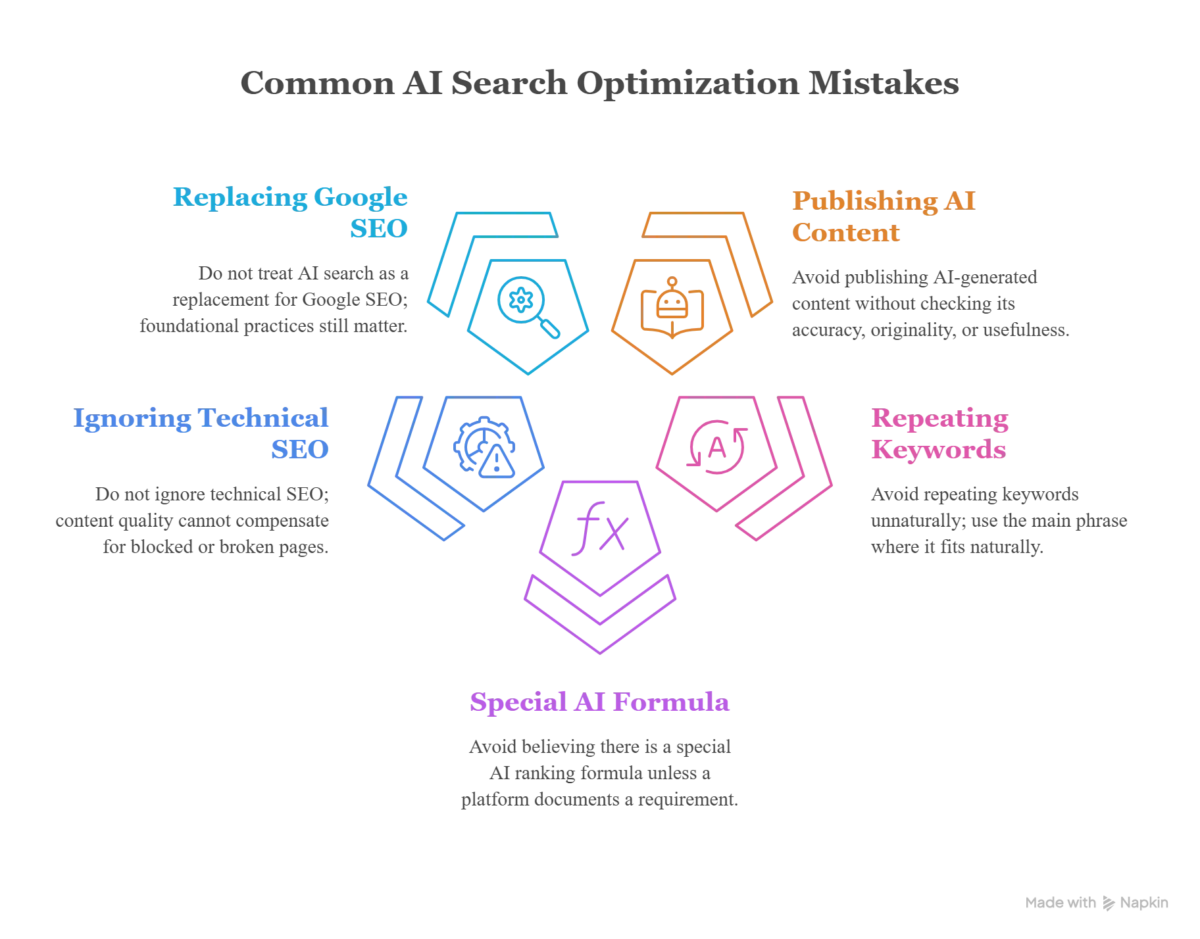
Publishing Large Volumes of AI-Generated Content
AI can help you brainstorm, organize research, create outlines, and improve a draft. Problems arise when you publish content without checking its accuracy, originality, or usefulness.
An article can be grammatically correct and still fail to answer the reader’s question. It can also repeat information already available on dozens of other websites without contributing anything meaningful.
Use AI to improve your process, but review the result carefully. Check the facts, verify the sources, add relevant context, and make sure the final article reflects your editorial standards.
Also Read: Google’s Guidance on Generative AI Content
In this guide, Google explains that appropriate use of AI is not inherently against its guidelines. The focus is on producing helpful, reliable content and avoiding practices intended to manipulate search rankings.
Repeating Keywords Unnaturally
Your primary keyword should help define the page’s subject. It does not need to appear in every heading, paragraph, and image description.
Use the main phrase where it fits naturally, and cover related concepts when they help readers understand the topic. An article about AI search optimization can discuss crawler access, content structure, source credibility, and referral measurement without repeating the primary keyword in every section.
Believing There Is a Special AI Ranking Formula
Be cautious of advice claiming that a specific word count, heading format, schema type, or number of citations guarantees inclusion in AI-generated answers.
Unless a platform documents a requirement, do not treat it as a confirmed ranking factor. Experimentation can be useful, but a tactic that appears to work in a few tests is not necessarily a universal rule.
Ignoring Technical SEO
Content quality cannot compensate for every technical problem. If important pages are blocked, broken, or incorrectly configured, you need to address those issues.
Review crawlability, indexability, canonical tags, redirects, page performance, and internal links as part of your normal website maintenance. Technical SEO and useful content work together, and neither should be neglected.
You May Find This Useful: What is Technical SEO – Basics and Best Practices | SEMRUSH Blog
Treating AI Search as a Replacement for Google SEO
Google remains an important discovery channel for many websites, and the same foundational practices continue to matter in its AI search experiences.
Do not abandon established SEO work to pursue an unverified AI tactic. Build a website that serves readers well across the discovery channels that matter to your audience.
A Practical 30-Day AI Search Optimization Plan
If you are unsure where to begin, use the next 30 days to establish a baseline and make a few focused improvements. You do not need to overhaul your entire website or publish dozens of new articles.
Week 1: Audit Your Website
Start with your most important pages. Choose a few articles that already attract relevant visitors or support your main business goals.
Check whether they are accessible, indexed where appropriate, properly linked, and free from obvious technical problems. Review your robots.txt file, security settings, canonical tags, and important URLs.
Record your current search performance and available AI referral traffic. This gives you a baseline for future comparisons.
Week 2: Improve Your Best Existing Articles
Choose two or three articles that deserve attention. Review their search intent, the depth of their explanations, and whether they answer the questions readers have.
Add missing context, correct outdated information, and include relevant examples. Improve headings and internal links where necessary. If an article makes claims about tools or search engine behavior, verify those claims against reliable sources.
Do not rewrite a page simply to make it longer. Make changes that improve its usefulness.
Week 3: Review AI Crawler Access and Content Structure
Check the official documentation for the AI services you want to reach. Review their crawler requirements and confirm that your website settings reflect your preferences.
Inspect the structure of your important pages. Make sure titles and headings accurately describe the content and that structured data, where used, reflects what readers can see.
You can also test a small set of relevant questions across AI search tools to understand which sources they cite and how they answer your audience’s questions. Record what you observe without assuming the results will remain identical.
Week 4: Measure, Learn, and Plan the Next Cycle
Review your search performance, referral data, and any manual AI visibility tests. Look for meaningful changes, but avoid drawing strong conclusions from a short observation period.
Ask yourself which pages have the clearest opportunities for improvement, which topics deserve more detailed coverage, whether important pages receive relevant visitors, and what technical problems still need attention.
Use those findings to prioritize the next month. The aim is to build a repeatable process that improves your website over time.
Frequently Asked Questions
1. How Do I Get My Website Cited by ChatGPT and Other AI Search Tools?
Start by making sure your important pages are publicly accessible and that your crawler settings align with the services you want to reach. Create useful, accurate content that answers specific questions, organize it clearly, and support important claims with reliable sources.
These steps can improve discoverability, but no technique guarantees a citation. Each service uses its own systems to retrieve and select information.
2. Is AI Search Optimization Different From Traditional SEO?
AI search optimization overlaps substantially with traditional SEO. Both benefit from accessible websites, useful content, clear structure, and an understanding of search intent.
AI-powered search adds other considerations, including how systems retrieve information, present citations, and generate answers. You should account for those differences without abandoning the SEO practices that already help people discover your website.
3. How Long Does AI Search Optimization Take to Show Results?
There is no universal timeline. Technical corrections may make a page accessible where it was previously blocked, but changes in indexing, retrieval, citations, and referral traffic depend on the platform and the circumstances.
Establish a baseline, make targeted improvements, and monitor performance over time. Avoid promises that your website will appear in AI-generated answers within a fixed number of days.
Final Thoughts
AI search optimization deserves a place in your digital marketing strategy because people now have more ways to discover information than they did when traditional search was the primary channel most website owners considered.
However, this does not mean you need to rebuild your website around every new AI tool. Start with what you can control: make your content accessible, understand what your audience is trying to accomplish, explain complex topics properly, support your claims with reliable evidence, connect related pages, and keep important information accurate.
If you already have a library of useful articles, review that content before rushing to publish dozens of new pages. Some of your strongest opportunities may be sitting in articles that need better explanations, clearer structure, or more practical examples.
AI search will continue to evolve, and individual platforms may change how they retrieve and present information. A strategy built around verified information, genuine usefulness, and sound technical foundations gives you a more durable starting point than one built around unproven shortcuts.
The goal is to create a website that deserves to be discovered and helps people when they find it. That is a worthwhile investment, regardless of which search interface they use.